Kitchen Table Selectors: Why the UK’s Most Honest Mixes Are Being Recorded at Home
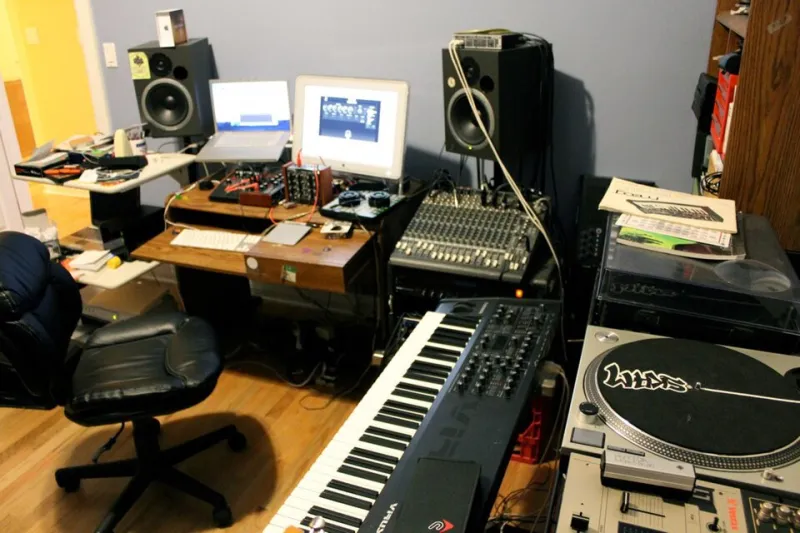
Photo: Jackknife Barlow, CC BY 2.0, via Wikimedia Commons
There is a particular sound to a mix recorded at home. You can hear the room before you hear the record: a laptop fan, a kettle clicking off, the slight boxiness of a bedroom with the window shut. Then the first blend arrives, maybe a little rough at the edges, and somehow that makes the whole thing easier to trust. In 2026, some of the most compelling UK mixes are not coming from club booths at all. They are coming from kitchen tables, box rooms and the corner of a flatshare living room.
The room before the record
Club mixes have their own thrill. The crowd noise, the pressure of a room, the sense that a set is happening once and then disappearing. But that format also hides things. It hides the selector’s nerves, their second-guessing, the moment they decide to abandon a plan and follow a thread. A home recording can leave some of that in. Not because the DJ is careless, but because the setting allows for a different kind of attention.
Listeners seem to be responding to that. A home mix often feels like being let in rather than sold to. There is no door policy, no bar queue, no need to fill a dancefloor. The selector can play the odd tempo, the strange B-side, the track that only makes sense at 11pm on a Tuesday. That freedom is part of the appeal.
Why imperfect blends travel further
A home-recorded mix does not have to be sloppy. It has to be honest. There is a difference. The best ones are still carefully built: levels are checked, the selection is deliberate, the arc is considered. But they are not sanded down until every transition sounds like a product demo. A blend that wobbles for half a bar can tell you more about a DJ than a perfectly quantised hour ever will.
That imperfection is also a reaction to the polish of club and festival sets. When every upload sounds like it was mastered for a headline slot, the home mix becomes a palate cleanser. You hear the records, the person and the room. You hear decisions being made in real time. For listeners hunting for a selector’s actual taste rather than their showreel, that is valuable.
The one-take contract
The one-take rule is central to the format. Many home mixes are recorded in a single pass, with mistakes left in and no post-production rescue. That creates a quiet contract with the listener: this is what happened, in this order, on this day. It is not a live set, but it has a similar honesty. The DJ cannot hide behind edits. They have to trust their ears and their preparation.
That honesty can be disarming. A selector who usually plays out in clubs might record a home mix that is slower, stranger and more personal. They might talk over the intro or leave a long silence between tracks. They might include a tune they would never play at peak time because it means something to them. Those choices do not always translate to a dancefloor. They do translate to a listener on a train, in headphones, looking for something that feels like a conversation rather than a broadcast.
Small setups, big personalities
You do not need a studio to make one of these mixes. A controller, a pair of headphones, a laptop and a half-decent interface can be enough. Some selectors use vinyl rigs that take up most of a spare room. Others record straight from a mixer into a phone, accepting the hiss as part of the charm. The modesty is not a gimmick. It is a condition of the format.
That matters in a UK context where space is tight and not everyone has access to a club booth. A home recording can be made after work, before a shift, or in the hour between flatmates going to bed and the neighbours starting to stir. It fits around real life. It also gives selectors who are not in a major city, or not in a regular club rotation, a way to be heard. The result is a wider range of voices than the club circuit alone can offer.
The limits of honesty
Honesty is not an excuse for a bad mix. A home recording still needs shape. It needs a reason to exist beyond the fact that it was easy to upload. The best home mixes have a clear idea, even if that idea is simply: these are the records I have been living with this month. They are curated, not just captured.
There is also a privacy question. A bedroom mix can feel intimate because it is intimate. Selectors are inviting strangers into a personal space, even if only through sound. The ones who do it well set their own boundaries. They decide what to share, what to leave out and how much of themselves to put in the description. That control is part of what makes the format work.
A letter, not a broadcast
Home-recorded mixes have become the UK’s most honest DJ format because they do not pretend to be something else. They are not trying to recreate a club night. They are not trying to compete with a festival stream. They are a direct line from one person’s room to another person’s headphones. In a culture that often rewards volume and polish, that is a quiet kind of radical. And in 2026, it is only getting louder.